
.jpg)
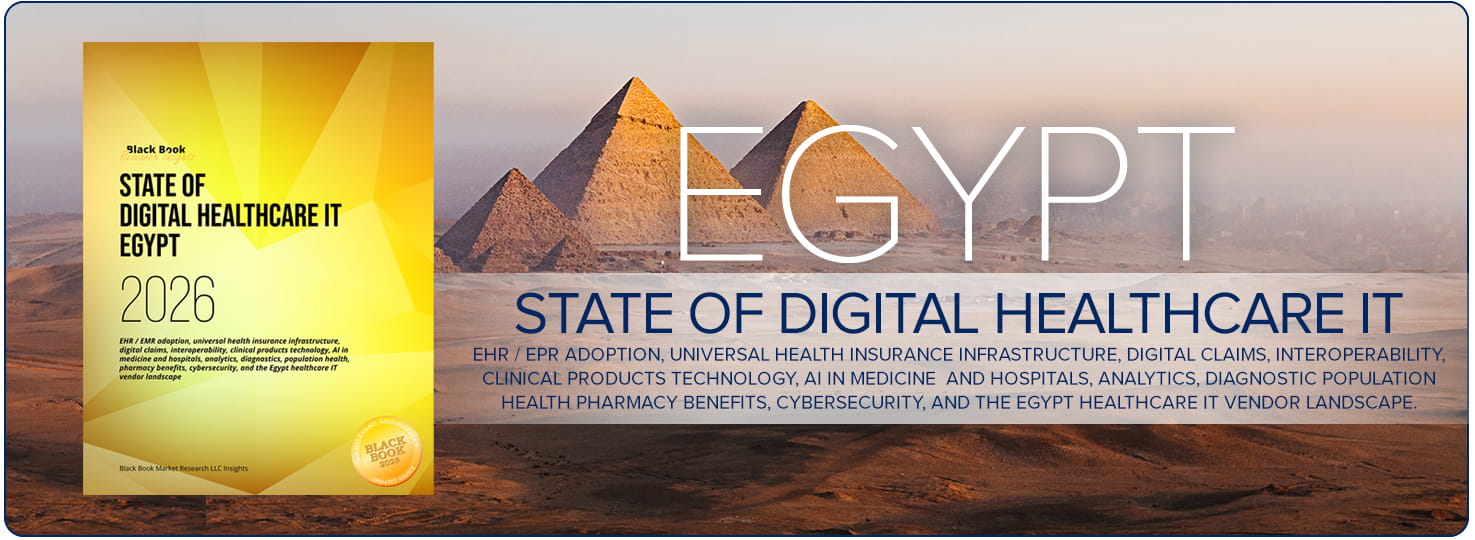
Download the Egypt State of Digital Healthcare IT 2026 Market Report
New from Black Book Research Insights: State of Digital Healthcare IT 2026: Egypt — a buyer-ready market report on EHR and EMR adoption, universal health insurance infrastructure, digital claims, interoperability, analytics, diagnostics, pharmacy technology, cybersecurity, AI, and Egypt’s healthcare IT vendor landscape.
The report examines Egypt’s healthcare IT transformation as Universal Health Insurance rollout, public hospital modernization, private-sector growth, digital pharmacy, diagnostics, telehealth, claims automation, and mobile patient access reshape the market through 2030.
Why this report, why now
Egypt is one of the most important healthcare IT growth markets in the Middle East and Africa. The country is moving from fragmented digitization toward a more coordinated health technology model built around universal coverage, payer discipline, provider readiness, accreditation, and digital access.
Egypt’s market is large, mixed, and complex. Public-sector demand is shaped by the Ministry of Health and Population, the Universal Health Insurance Authority, the General Authority for Healthcare, GAHAR, the Unified Procurement Authority, and eHealth Company. Private hospitals, clinics, labs, pharmacies, insurers, employers, TPAs, and healthtech platforms are creating parallel demand for digital tools.
Two procurement realities are now decisive
-
Egypt is a high-growth healthcare IT market where universal health insurance, public-provider reform, private healthcare expansion, digital pharmacy, diagnostics, claims automation, and mobile access are converging.
-
EHR adoption remains uneven. Some private networks and UHI-enabled facilities are advancing quickly, while many public and independent providers still operate with mixed paper and digital workflows.
-
Universal Health Insurance is the main public-sector driver. It requires enrollment, eligibility, provider contracting, claims, coding, pricing, accreditation evidence, quality reporting, and payment controls.
Market signals at a glance
-
Egypt is not a simple EHR replacement market. It is a staged modernization market where public infrastructure, private provider systems, digital claims, pharmacy access, diagnostics, telehealth, and patient engagement must develop together.
-
Winning vendors will need Arabic-language usability, UHI readiness, claims and coding capability, local implementation support, cybersecurity controls, affordability, and measurable operational value.

-
Digital claims and medical coding are becoming essential infrastructure for payer sustainability, utilization review, fraud control, and provider performance measurement.
-
Digital pharmacy and diagnostics are major growth areas, including prescription capture, medication delivery, chronic refills, LIS, RIS/PACS, teleradiology, structured reporting, and AI-supported workflows.
-
AI adoption will be practical and workflow-led, with strongest demand in radiology, pathology, documentation, coding, claims review, queue management, chronic disease support, and patient communication.
-
Cybersecurity is becoming a procurement requirement as hospitals, claims platforms, pharmacies, telehealth services, labs, imaging systems, cloud platforms, and connected devices become more integrated.
-
The report includes a 70-vendor and operator directory covering national authorities, Egyptian healthtech firms, provider groups, pharmacy and diagnostics platforms, payers, cloud providers, cybersecurity suppliers, and global healthcare IT vendors.
What the report covers
The State of Digital Healthcare IT 2026: Egypt report provides market intelligence across:
-
EHR / EMR adoption: Public and private provider digitization, hospital systems, clinic management, UHI-enabled facilities, documentation, patient administration, and paper-to-digital transition.
-
Universal Health Insurance infrastructure: Enrollment, eligibility, claims, coding, pricing, contracting, utilization review, accreditation, and payment workflows.
-
Interoperability and integration: UHI platform links, patient identity, Arabic data capture, diagnostic results, pharmacy transactions, payer workflows, HL7, APIs, and practical public-private integration.
-
Clinical products technology: HIS, EMR, LIS, RIS/PACS, pharmacy, inventory, scheduling, referrals, emergency workflows, telehealth, home services, and patient engagement.
-
AI and analytics: Diagnostic AI, claims analytics, coding support, documentation tools, population health, chronic disease management, provider performance, and fraud-waste-abuse detection.
-
Cybersecurity and data governance: Identity controls, access management, endpoint security, cloud security, backup, disaster recovery, audit logs, privacy, supplier risk, and AI governance.
-
Current trends: UHI rollout, digital claims, uneven EHR maturity, pharmacy platform growth, diagnostics digitization, mobile-first access, pragmatic AI adoption, cybersecurity, and local implementation capacity.
-
Vendor landscape: A 70-vendor Egypt HIT directory covering public infrastructure, providers, payers, diagnostics, pharmacy, telehealth, digital mental health, cloud, analytics, cybersecurity, imaging, and enterprise health IT.