
.jpg)
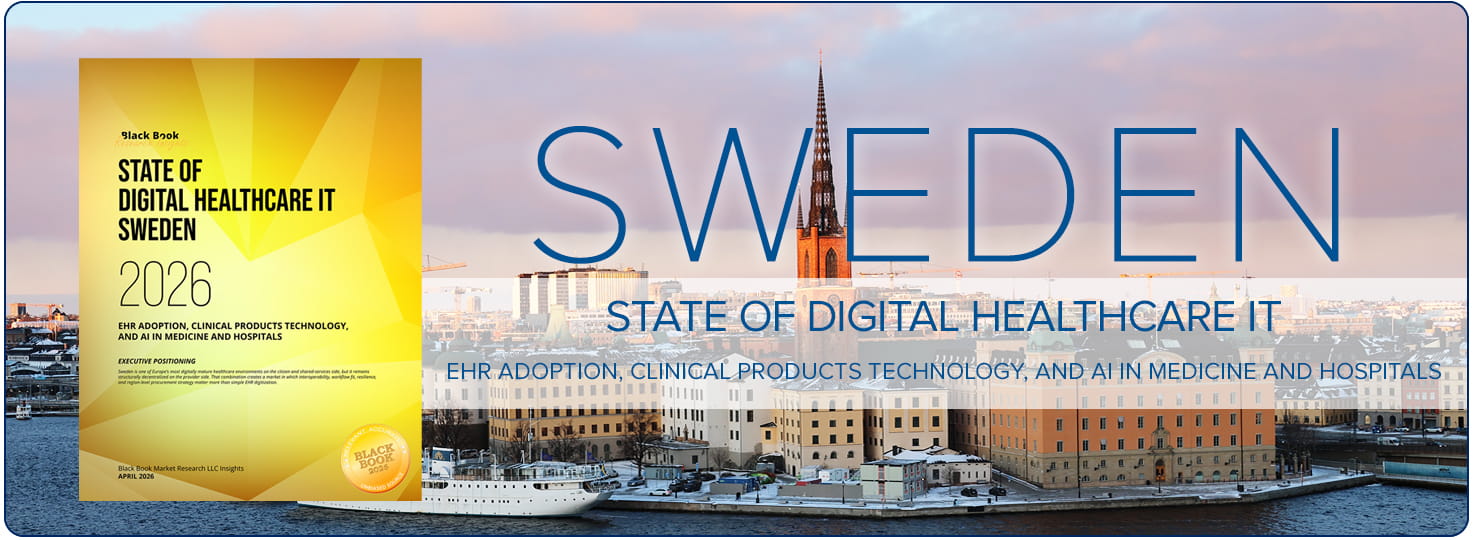
Download the Sweden State of Digital Healthcare IT 2026 Market Report
New from Black Book Research Insights: State of Digital Healthcare IT 2026: Sweden — a qualitative, buyer-ready market report on the state of EHR adoption, clinical products technology, and AI in medicine and hospitals across one of Europe’s most digitally mature, but structurally decentralized, healthcare environments. The report examines Sweden’s strong national and shared-services layer, region-led provider modernization, interoperability priorities, medication and imaging infrastructure, procurement risk, and the vendor and policy dynamics shaping healthcare IT decisions across the 2026-2030 planning horizon.
Why this report, why now
Sweden enters 2026 with digital health moving beyond the question of whether infrastructure exists and into a more demanding phase of operational performance. Citizen-facing access, medication visibility, patient record access, and cross-provider information-sharing are already well established. Buyers are increasingly focused not on first-wave digitization, but on how effectively digital systems support workflow, interoperability, resilience, patient continuity, and measurable operating value.
At the same time, Sweden is not one uniform healthcare IT market. It is a federation of 21 self-governing regions with different legacy estates, procurement strategies, modernization timelines, implementation capacities, and tolerance for transformation risk. That changes where vendors win, how they position, and which capabilities matter most.
Two procurement realities are now decisive:
-
Sweden is not a single-platform healthcare IT market; it is a high-maturity, region-led environment where strong national digital services coexist with meaningful provider-side variation.
-
Winning increasingly depends on workflow fit, interoperability, implementation realism, modular architecture, imaging and medication integration, governance readiness, and the ability to deliver operational gains without destabilizing care delivery.
Modernization in Sweden is now being judged not only by core platform functionality, but by usability, resilience, change-management discipline, interoperability with national services, specialty workflow support, and the ability to improve care operations under real staffing and governance conditions.
Market signals at a glance
Selected indicators and market themes highlighted in the report underscore the scale and direction of digital healthcare momentum in Sweden:
-
Sweden is one of Europe’s most digitally mature healthcare environments on the citizen and shared-services side, but remains structurally decentralized on the provider side.
-
The national foundation is strong: 1177 functions as the digital front door for citizens, Journalen provides broad patient access to records, Nationell patientöversikt (NPÖ) supports provider visibility across organizations, and the Nationella läkemedelslistan (NLL) is now connected across all regions.

-
Sweden is not a single-platform country. It is a federation of digitally capable healthcare environments with different regional procurement philosophies, modernization cycles, and legacy application estates.
-
EHR adoption is already mature across hospital and ambulatory care, but the next stage of the market is being shaped by regional modernization cycles, not first-wave deployment.
-
Procurement strategy is shifting away from blind faith in one-size-fits-all transformation programmes and toward more modular, governable, and regionally realistic architectures.
-
Imaging, diagnostics, digital treatment workflows, referral coordination, and cross-setting information access are becoming more central to operational effectiveness than standalone core-record functionality alone.
-
AI in Swedish healthcare is becoming practical rather than theoretical, led first by imaging support, clinical documentation assistance, digital intake and triage, classification support, scheduling, and selected workflow optimization use cases.
-
The Swedish market is increasingly being shaped by four strategic decision domains: clinical and operational effectiveness, interoperability and innovation, resilience and governance, and partnership and long-term strategic alignment.