
Download the 2027 Black Book Healthcare Policy Outlook Report
Federal and state direction. Reimbursement. Data privacy. Regulatory compliance.
Black Book Research presents a comprehensive examination of the healthcare policy issues shaping 2027 financial planning, technology investment, clinical operations and patient access across the United States.
The 66-page September 2026 edition brings together 18 sections, 84 primary-source references and a 20-question executive survey instrument, with coverage spanning health systems, hospitals, physician organizations, laboratories, imaging, ancillary services, long-term care, post-acute providers and health plans. Its research cutoff is September 15, 2026.
The report distinguishes the 2026 policy record, established 2027 requirements and decisions that remain contingent, connecting each area to the organizational work required for implementation. Its central message is practical: understanding a policy is not the same as being ready to operate under it.
From Policy Headlines to 2027 Operating Decisions
The outlook is organized around three questions facing healthcare leadership:
-
What changed during 2026? A review of the policy developments, implementation actions and revised requirements covered through the report’s research cutoff.
-
What is established for 2027? An examination of the commitments and milestones that belong in organizational planning, with attention to the affected entity, population, payment system and jurisdiction.
-
What remains unresolved? A separate assessment of proposals, expiring provisions, implementation dependencies and other decisions that should remain visible in scenario planning.
The executive summary connects eight themes: coverage continuity, reimbursement, state-level variation, data integrity, human accountability for automated decisions, coordination across care settings, funding and workforce dependencies, and demonstrated operating readiness. These are presented as Black Book’s analysis of the policy record—not as a prediction that every proposal will become law.
One Healthcare Policy Outlook, Three Connected Operating Priorities
Coverage, Reimbursement and Financial Planning
The report examines federal coverage and Medicaid policy alongside reimbursement across care settings, health-plan administration, drug policy, price transparency and payment disputes.

Its financial analysis preserves the differences among hospital payments, physician-service economics, diagnostic services, long-term care and post-acute delivery. Rather than treating one national payment announcement as an enterprise-wide revenue forecast, the report emphasizes facility-level, specialty-specific and service-line planning.
Data Privacy, Cybersecurity and Digital Accountability
The digital-policy sections bring together privacy, cybersecurity, clinical resilience, interoperability, prior authorization and artificial intelligence. They connect technology decisions with questions about data integrity, clinical ownership, appropriate human review and the ability to use information across organizational boundaries.
The emphasis extends beyond installing a system or completing an interface. Black Book’s analysis asks whether the resulting process supports a usable clinical decision, a reliable transfer of information and an accountable route for resolving exceptions.
Clinical Delivery, Workforce and Patient Access
The outlook also examines delivery and payment models, workforce dependencies, public health, accessibility and the relationships among hospitals, physicians, diagnostics, nursing facilities and home-based providers.
Its operating perspective follows care beyond the individual encounter, emphasizing medication reconciliation, diagnostic follow-up, transfer acceptance, staffing capacity and caregiver readiness. The report treats these as shared responsibilities that require coordination across the healthcare continuum.
A State-Specific View of Healthcare Policy
The state-policy section includes profiles of California, Colorado, Maryland, Massachusetts, Minnesota, New York, Oregon, Texas and Washington.
These discussions examine different combinations of healthcare AI, automated decisions, spending accountability, hospital cybersecurity, consumer privacy and professional-practice governance. They are selected state examples—not an exhaustive fifty-state legal review.
State-outline graphics and locator maps accompany the analysis. A state implementation checklist helps readers organize the relevant agencies, affected entities, requirements, reporting channels and internal owners for their own operating footprint.
A Provider-Specific View of the Healthcare Continuum
The report does not treat healthcare organizations as one interchangeable market. Its provider and payer assessment connects policy exposure with the distinct financial, clinical and data responsibilities of each setting.

Hospitals and physician organizations: Integrated systems, academic and specialty hospitals, independent and rural hospitals, critical access hospitals, physician groups and ambulatory practices receive separate consideration, including the relationship between enterprise planning and local service delivery.
Diagnostics and ancillary services: Dedicated coverage addresses clinical laboratories, pathology, molecular diagnostics, imaging, radiology, ambulatory surgery, dialysis, infusion, therapy and durable medical equipment. The analysis preserves differences in reimbursement, ordering evidence, quality oversight and information exchange.
Long-term, post-acute and home-based care: The report distinguishes nursing facilities, skilled nursing, long-term care hospitals, inpatient rehabilitation, home health, hospice, home- and community-based services, PACE and hospital at home. Behavioral health, substance-use-disorder services, health plans and employers also have distinct coverage.
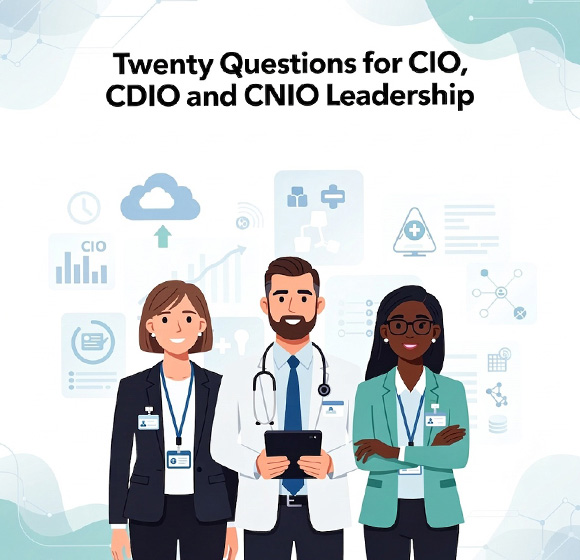
Twenty Questions for CIO, CDIO and CNIO Leadership
The executive section includes a 20-question survey instrument and reporting framework addressing policy accountability, implementation readiness, budget allocation, financial assumptions, care interruptions, authorization, privacy, recovery exercises and clinical oversight.
One question follows separate leadership routes: the CIO route addresses testing with external trading partners; the CDIO route examines the evidence supporting expected savings; and the CNIO route addresses nursing work in discharge and care-transition coordination.
The instrument also asks what government implementation support would be useful and which unresolved policy question most affects the organization’s 2027 decisions.
Practical Tools for Executive Teams and Boards
The report pairs its narrative with reimbursement comparisons, state-policy visuals, an implementation calendar and operating-readiness frameworks.
Its executive tools support four connected tasks: identify the governing requirement, assign ownership and resources, test the complete workflow, and retain evidence that the process operates as intended. The calendar distinguishes different kinds of milestones rather than treating every effective date, compliance deadline and expiration as the same event.
Why This Report Matters
Black Book’s conclusion is that policy readiness requires coordination across finance, technology, clinical leadership, compliance and government affairs. A financial forecast, a configured application and a written policy each provide part of the picture; none independently demonstrates that an organization is ready to deliver the required process.
The 2027 Black Book Healthcare Policy Outlook provides a common framework for connecting those responsibilities while preserving the differences among provider settings, state requirements and policy status.