
.jpg)
Download the Hospital & Health System Outsourcing 2027 Outlook Report
Funding AI. Protecting care. Validating savings. Workforce continuity. Vendor accountability. Shared leadership decisions.
Black Book Research presents a comprehensive examination of the outsourcing, managed services and operating capabilities supporting U.S. hospitals and health systems in 2027—with a practical focus on how boards, chief information officers and chief financial officers can evaluate proposals, verify economics and protect essential services.
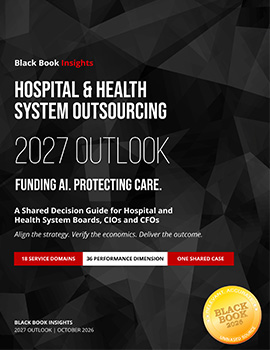
The 94-page October 2026 edition brings together 18 service domains, 36 qualitative performance dimensions, 87 vendor profiles and four leadership working papers. The report combines market outlooks, service-specific purchasing guidance, an integrated decision framework and a cross-referenced vendor directory to support procurement, budgeting, implementation and renewal.
From Outsourcing Proposals to Verified AI Funding
The central 2027 question is whether changing how a hospital operates can release usable cash, support sustainable AI investment and preserve the care, capacity and capabilities the organization depends on.
Black Book examines the connection between three distinct decisions: which service should change, which AI investment deserves funding and whether the proposed savings can reliably finance that investment.
Lower vendor fees, recovered staff time and deferred implementation charges have different financial consequences. The report helps leadership distinguish recurring cash savings from avoided future costs, additional capacity and changes in payment timing.
Its practical buying test is direct: what cash becomes available, when can it be used, what obligations remain and what happens if the expected savings do not materialize?
Eighteen Service Domains Across the Hospital Enterprise
Hospital outsourcing extends well beyond IT and revenue cycle management. The report examines the services that determine whether clinical teams, administrative operations and the physical care environment can function reliably.
Coverage includes:
-
Portfolio: Sequence procurements around shared policy, data, identity, integration, testing, security, and workforce dependencies rather than treating each module expiration or regulatory date as an isolated project.

-
Revenue cycle and patient access: end-to-end revenue operations; patient access and prior authorization; HIM, coding, clinical documentation improvement and records; and denials, receivables and underpayments.
-
Workforce and clinical services: workforce administration and sourcing; contracted clinical services; virtual care and virtual nursing; laboratory, imaging and pathology; and pharmacy and medication services.
-
Enterprise and support operations: procurement, supply chain and logistics; facilities, biomedical equipment and clinical assets; environmental, food and support services; care transitions and transport; and corporate and administrative services.
Each domain connects its 2027 outlook to purchasing questions, performance evidence and the responsibilities hospital leadership must retain.
One Shared Decision for Boards, CIOs and CFOs
Outsourcing and AI proposals frequently cross governance, technology and finance boundaries. The report gives these leadership groups a common framework for evaluating the same commitment.
-
Boards and trustees establish strategic priorities, mission safeguards, material approval conditions and acceptable risk.
-
CIOs substantiate capability, integration, data readiness, cybersecurity, implementation requirements and ongoing operating ownership.
-
CFOs validate the complete financial commitment, transition cash needs, retained costs, allocation of savings and recurring affordability.
Clinical and operating leaders validate the consequences for patients, staff and service delivery. Together, these perspectives support one coordinated business case with defined responsibilities, measurable outcomes and clear conditions for reconsideration.
The Cash-to-AI Funding Test
A proposal to fund AI through outsourcing must establish more than a reduction in one budget line.
The report examines the full financial bridge: comparable current costs, supplier charges, retained staffing, technology expenses, transition overlap, oversight, approved savings allocation and the complete cost of operating AI.
It also introduces two questions that expose important dependencies:
-
Would the hospital still approve the outsourcing arrangement if the AI project were cancelled?
-
Would it still fund the AI project if the outsourcing savings did not occur?


These questions help leadership evaluate alternatives, including improved in-house delivery, shared services, co-management, targeted outsourcing and staged AI deployment.
Thirty-Six Performance Dimensions: Delivery and the Company Behind It
Black Book’s experience framework separates 18 service-performance KPIs from 18 corporate-relationship KPIs, giving buyers two complementary ways to assess an outsourcing arrangement.
Service-performance dimensions address functional fit, transition quality, expertise, workforce continuity, accuracy, timeliness, integration, automation effectiveness, patient experience, security execution, continuity readiness and realized economic value.
Corporate-relationship dimensions examine executive sponsorship, governance, responsiveness, ownership and financial transparency, pricing clarity, contract fairness, subcontractor visibility, data portability, workforce conduct, exit cooperation and alignment of incentives.
The framework supports evaluation within a defined service scope and observation period, helping leadership connect day-to-day performance with the conduct and accountability of the supplier.
An 87-Profile Vendor Directory Built Around Purchasing Decisions
The cross-referenced directory connects 87 vendor profiles with the report’s 18 service domains, supported by company-source links, functional and alphabetical indexes, and related-business references.
Each profile combines a description of published services with contract considerations tailored to hospital purchasing discussions. Readers can examine the work being transferred, the capabilities that remain internal, financial dependencies and continuity requirements.
The directory supports market exploration and due diligence. Inclusion identifies relevant published capabilities; it does not constitute a vendor ranking or endorsement.
Protecting Care, Workforce and Operational Continuity
Financial improvement must remain connected to the hospital’s ability to deliver dependable care.
The report examines patient access, clinical escalation, staffing stability, institutional knowledge, information security, subcontractor dependencies and recovery arrangements. It also addresses whether savings and disruption fall unevenly across hospitals within a system.

Guidance distinguishes the needs of small and critical access hospitals, community hospitals, regional and multistate systems, investor-owned organizations, and academic, public and safety-net institutions.
Across these settings, the emphasis is on clear service boundaries, affordable retained capability, accountable handoffs and a workable continuation or exit plan.
Practical Working Papers for Approval, Oversight and Renewal
Four leadership working papers help organizations:
-
Define the hospital, service scope, operating alternatives and decision requested.
-
Build a shared financial and AI evidence record.
-
Document safeguards, responsibilities and continuity arrangements.
-
Compare approved commitments with actual outcomes and make deliberate renewal decisions.
The report’s 2027–2028 agenda connects initial authorization with transition readiness, AI production approval, six- and twelve-month reviews, and subsequent renewal or redesign.
Leadership can use these tools to determine whether to continue, correct performance, provide explicit additional funding, change scope, replace a supplier or bring selected work back internally.

Why This Report Matters
Black Book’s central conclusion is that outsourcing can support AI investment only when the financing connection is demonstrated and the resulting operating model remains affordable, accountable and protective of care.
A credible proposal connects the service change, the investment and the funding. A successful arrangement proves that connection through realized cash, dependable execution and measurable outcomes.