
Download the State Of Medicaid Enterprise Technology 2026-2028 Report
Black Book Research has published a 261-page national buyer-intelligence, market-opportunity, and vendor-benchmark study to help state Medicaid executives, Medicaid Enterprise Systems leaders, CIOs and enterprise architects, eligibility and claims operations teams, data and analytics leaders, provider and managed-care oversight organizations, procurement and contracting officials, technology suppliers, fiscal agents, systems integrators, independent verification and validation firms, cloud and cybersecurity providers, and specialist services companies identify where the most consequential Medicaid technology investments and acquisition opportunities are developing through 2028.
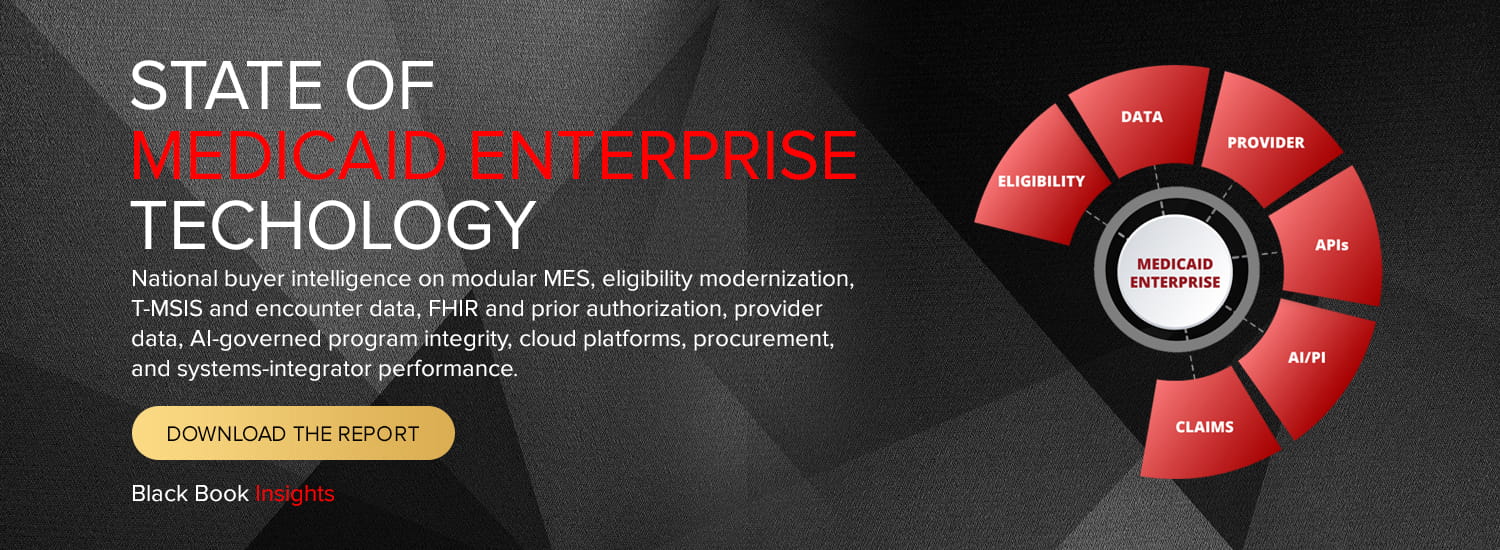
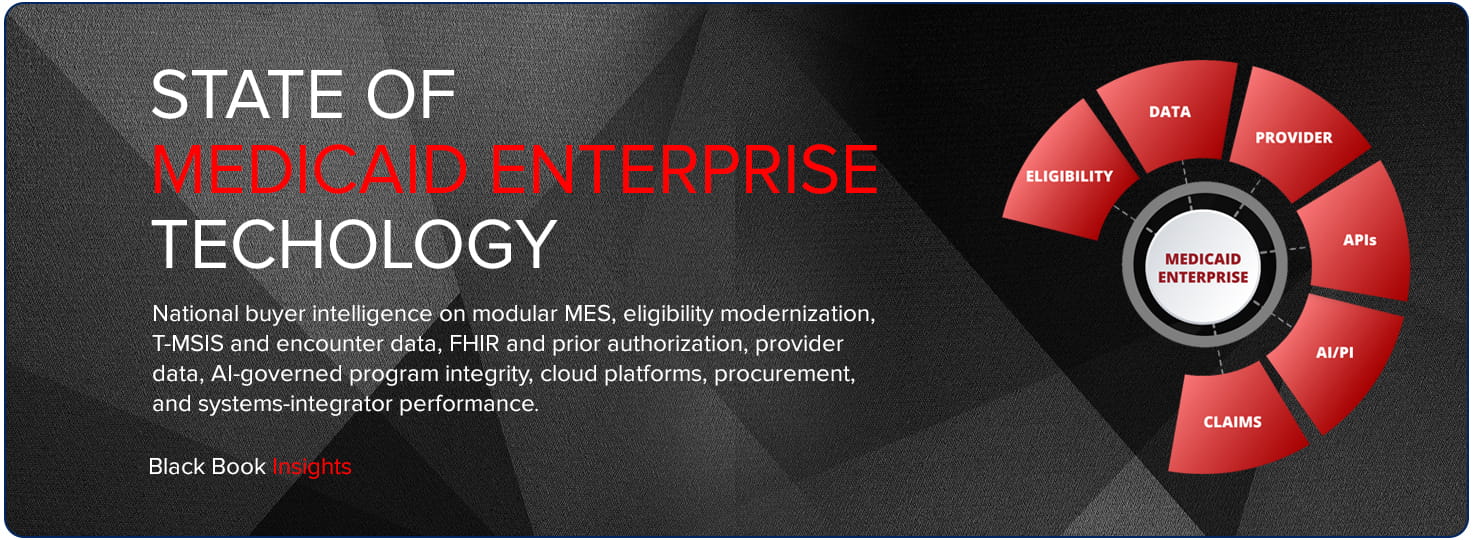
The report provides national buyer intelligence on modular MES, eligibility modernization, T-MSIS and encounter data, FHIR and prior authorization, provider data, AI-governed program integrity, cloud platforms, procurement, and systems-integrator performance.
Built as an executive-ready market, operating-model, and procurement analysis, the study evaluates Medicaid modernization as a portfolio of interconnected enterprise capabilities rather than as one national MMIS replacement cycle. It examines whether modular components can actually be replaced, whether eligibility evidence and policy rules can operate as an auditable service, whether data defects can be corrected at their operational source, whether APIs produce dependable workflow outcomes, whether provider records can support enrollment and access oversight, whether AI preserves human accountability, and whether cloud and multi-vendor environments remain secure, observable, economically defensible, and transferable.
The analysis is anchored in a scenario-calibrated, buyer-side analytic sample of 684 qualified Medicaid technology, operations, procurement, managed-care, and independent-oversight participants. Results are weighted to limit overrepresentation by any single state, organization type, role, program size, or vendor relationship. The participant base includes state Medicaid executives and MES directors; architecture, data, cloud, cybersecurity, and interoperability leaders; eligibility, provider, program-integrity, pharmacy, TPL, and claims operators; managed-care technology executives; procurement and contracting officials; IV&V and implementation-governance specialists; and provider-access leaders.
Black Book applies one Medicaid-specific 18-KPI performance framework across 14 functionally distinct vendor categories and 13 procurement workstreams. The scorecard evaluates federal-funding and certification readiness, modular replaceability, policy agility, interoperability, T-MSIS and enterprise-data integrity, payment accuracy, eligibility performance, provider-data accuracy, program integrity, prior authorization, cloud and FinOps, cybersecurity, AI governance, accessibility, implementation discipline, total value, and vendor accountability. The report deliberately avoids combining unlike products, platforms, infrastructure providers, integrators, and managed services into a single overall Medicaid technology ranking.
The market’s scale is substantial. Medicaid covered approximately 67.1 million people in March 2026, with CHIP adding another 7.2 million, for combined enrollment of 74.3 million. CMS enhanced federal participation can cover 90% of qualifying design, development, and installation activity and 75% of qualifying system operations, making Medicaid one of the largest and most consequential public-sector health technology markets in the United States.

The study finds that 82% of the national benchmark expects at least one major procurement, recompetition, replacement, or material contract amendment by the end of 2028. Eligibility, enrollment, renewal, and evidence verification leads the purchasing hierarchy at 76%, followed by T-MSIS, encounter-data quality, enterprise data, and analytics at 73%; FHIR interoperability and electronic prior authorization at 69%; provider enrollment, identity, directory, and network accuracy at 65%; AI-enabled program integrity at 61%; and enterprise integration, API management, master data, and orchestration at 58%. Systems integration, PMO, IV&V, testing, claims modernization, cloud, cybersecurity, pharmacy, TPL, LTSS, EVV, care management, and access analytics complete a broad portfolio of expected buying activity.
A dedicated 50-state Medicaid enterprise technology matrix and state-profile portfolio extends the national benchmark into specific acquisition environments. Each state profile applies a consistent structure covering enterprise posture, near-term acquisition signal, evidence strength, publicly visible activity, incumbent and operating-partner relationships, procurement status, implementation timing, innovation signals, regulatory drivers, and Black Book’s market outlook. The underlying public-source information was reviewed through July 26, 2026, with readers directed to verify current amendments, awards, and schedules through official procurement portals before making commercial decisions.
The state analysis finds that 42 of 50 states carry a High or Very High near-term acquisition signal, based on open competitions, announced transitions, implementation activity, or active modernization programs. Sixteen states have at least one publicly identified open or response-window procurement in the profiles. Five states are characterized primarily by core replacement or reprocurement, 17 by broader modular enterprise transformation, 18 by targeted module or service acquisition, eight by post-go-live stabilization, and two by stable-incumbent continuous improvement.
The findings show that modularity is widespread, but economically credible replaceability remains uncommon. Only 9% describe module replaceability as proven through an actual completed replacement. Another 27% consider replacement feasible with moderate dependency remediation, while most report that replacement is technically possible but high-cost or high-risk, or not realistic within the current architecture. Proprietary data models, undocumented business rules, vendor-controlled middleware, incomplete test assets, duplicated identities, shared batch dependencies, and institutional knowledge concentrated in a small number of individuals remain major barriers.
Integration accountability has consequently become the central Medicaid operating risk. Seventy-one percent say multi-vendor integration risk now exceeds the operational risk associated with the claims engine itself, and 74% identify unclear ownership of cross-vendor failures as a major concern. Only 16% report full state visibility across the end-to-end transaction chain. The report calls for state-governed definitions, shared identifiers, transaction correlation, common severity rules, automated end-to-end testing, coordinated release governance, and explicit contractual responsibility for multi-party production failures.


Eligibility, data, interoperability, and provider operations show equally significant execution gaps. Only 8% describe the required eligibility capabilities as production-ready. Forty-eight percent of significant data defects are attributed primarily to upstream operational systems, and only 14% report complete encounter reconciliation across payment, eligibility, provider, and service data. Seventy-one percent report additional work before 2027 interoperability and prior-authorization capabilities are production-ready, while only 13% report an authoritative enterprise provider master capable of supporting the full range of Medicaid operational uses.
AI adoption is expanding most rapidly in claims-anomaly detection, document processing, investigation prioritization, record matching, evidence review, provider screening, and administrative workflow. However, governance maturity trails implementation: only 12% report enterprise model governance in production, and only 7% would permit AI to execute an adverse eligibility, authorization, payment, or provider action without human review. The report requires model inventories, permitted-use controls, data provenance, reproducible historical recommendations, explainability, drift monitoring, override capture, differential-impact testing, and meaningful human accountability.
Cloud programs are demonstrating resilience and scalability more consistently than financial savings. Fifty-eight percent have not demonstrated net operating savings from cloud migration, and only 24% can
calculate technology costs at the product or transaction level. Systems-integrator performance presents a related concern: only 23% rate integrator performance as consistently strong, with schedule realism, cross-vendor defect ownership, risk escalation, test coverage, and knowledge transfer identified as recurring weaknesses.
The report organizes executive decision-making around four leadership tests:
-
Portfolio: Sequence procurements around shared policy, data, identity, integration, testing, security, and workforce dependencies rather than treating each module expiration or regulatory date as an isolated project.
-
Acceptance: Tie milestones, service levels, and payments to reconciled production outcomes and complete beneficiary, provider, worker, plan, and financial journeys.
-
Control: Retain unrestricted access to data definitions, configurations, interfaces, test assets, telemetry, operating evidence, documentation, and transition materials.
-
Differentiation: Compare vendors on the cost and risk of policy change, correction, scaling, integration, and replacement—not on product breadth, installed base, or presentation quality alone.

To keep unlike technologies from being forced into an artificial universal ranking, the vendor section presents modeled leadership separately across 14 evaluation categories. Modeled leaders include Gainwell Technologies for claims and financial core; Deloitte for eligibility and enrollment and for systems integration and PMO; Deloitte HealthInteractive for integration and orchestration; SAS for data, T-MSIS, and analytics and for AI and program integrity; HHS Technology Group for provider data and management; Edifecs for interoperability and prior authorization; Amazon Web Services for cloud and platform modernization; GDIT for cybersecurity and identity; MedImpact Healthcare Systems for pharmacy technology and services; Gainwell Technologies/HMS heritage for third-party liability; CSG Government Solutions for IV&V and quality engineering; and HHAeXchange/Sandata for LTSS, EVV, and care operations. The report explicitly states that these are category-specific, scenario-calibrated modeled respondent composites—not one overall Medicaid technology winner.
The strategic-recommendations section translates the benchmark into 12 actions for state Medicaid executives. These include owning the enterprise control plane, organizing roadmaps around dependencies, making source data quality an operating obligation, managing policy as version-controlled production content, testing complete public-service journeys, contracting explicitly for AI governance, measuring technology unit economics, separating product delivery from integration and independent assurance, creating enterprise observability, converting knowledge transfer into measurable work, designing every contract for exit, and publishing operating outcomes rather than implementation activity.
The report also provides an RFP and contracting framework covering unrestricted state data and configuration rights, open integration, production evidence, cross-vendor accountability, AI controls, cloud and FinOps requirements, knowledge transfer, annual exit-readiness validation, key-person continuity, subcontractor visibility, service-level remedies, and realistic end-to-end acceptance testing.
What the Report Helps You Do
Prioritize the strongest state and technology-market opportunities. Use the 50-state market matrix, state acquisition signals, procurement records, implementation calendars, and 13-workstream purchasing hierarchy to distinguish immediate competitions, active evaluations, transition programs, modular expansion, post-go-live optimization, and longer-term monitoring opportunities.


Separate real modularity from contractual or architectural labeling. Determine whether modules can be replaced without reconstructing the enterprise by evaluating state ownership of data, identities, interfaces, business rules, test assets, operational telemetry, documentation, and institutional knowledge.
Evaluate vendors within the correct competitive category. Apply the report’s 18 Medicaid-specific KPIs and category-specific scoring emphasis to compare claims platforms, eligibility systems, integration services, T-MSIS and analytics vendors, provider-data platforms, interoperability solutions, AI and program-integrity tools, cloud providers, cybersecurity firms, pharmacy and TPL services, integrators, IV&V organizations, and LTSS and EVV technologies.
Prepare for the compressed 2026–2028 implementation cycle. Coordinate standardized MES planning, T-MSIS Version 4, eligibility and evidence-verification changes, FHIR APIs, electronic prior authorization, provider-directory accuracy, managed-care oversight, cybersecurity, AI governance, and cloud operations around shared enterprise dependencies rather than separate compliance projects. The report characterizes the market as moving from compliance and architecture triage in 2026 to implementation compression in 2027 and structural correction, recompetition, and scale in 2028.
Strengthen RFPs, contracts, and production acceptance. Convert abstract requirements for interoperability, data ownership, accountability, responsible AI, cloud value, knowledge transfer, and exit readiness into measurable evidence, service levels, remedies, annual validation, and complete end-to-end operating tests.
Build a more defensible Medicaid market strategy. Use the buyer benchmark, vendor-category analysis, 50-state profiles, procurement signals, business-model outlook, and quarterly monitoring indicators to support account targeting, partnership decisions, bid qualification, product positioning, implementation staffing, investment priorities, and competitive planning through 2028.