
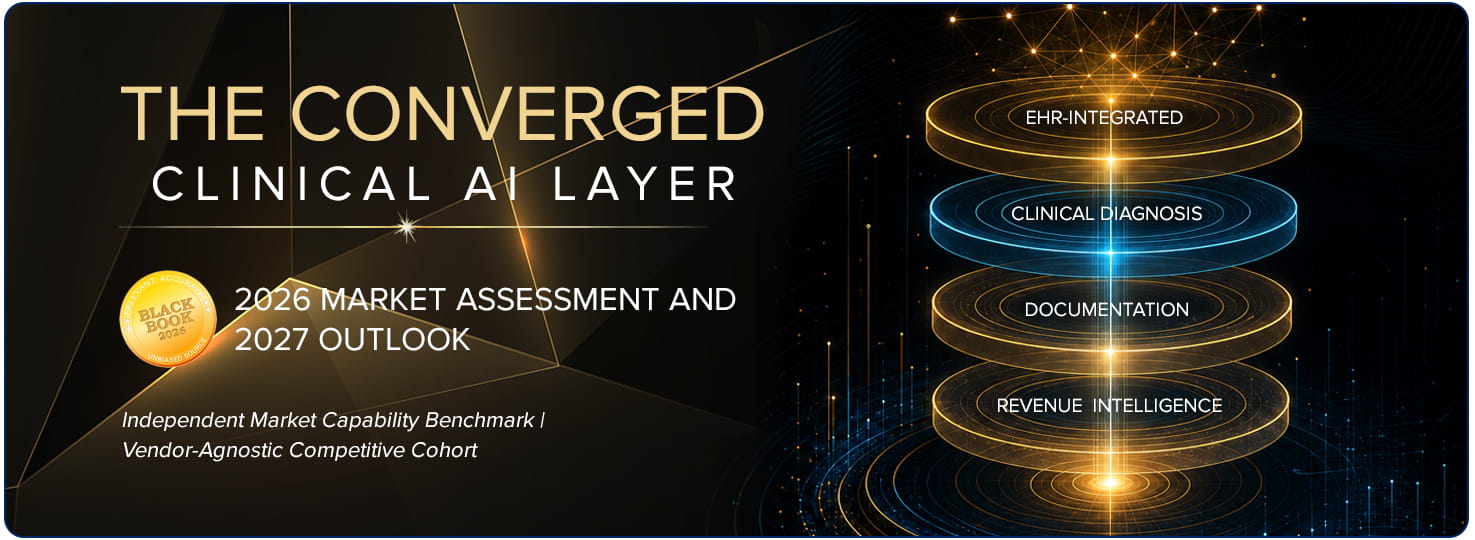
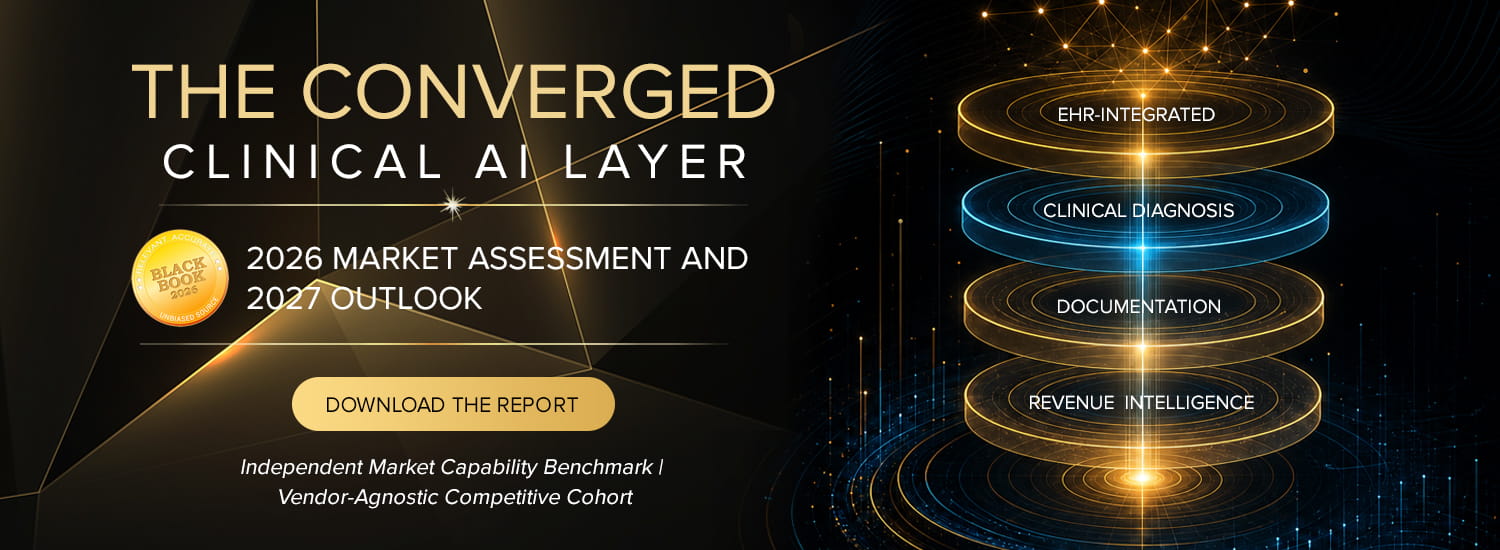
Download The Converged Clinical AI Layer: EHR-Integrated Clinical Diagnosis, Documentation and Revenue Intelligence Platforms
2026 Market Assessment and 2027 Outlook
Black Book Research has published a 56-page independent market-capability and competitive-intelligence report to help health-system executives, CIOs, CMIOs, AI and digital leaders, physicians, clinical-informatics teams, HIM and CDI executives, coding and revenue-integrity organizations, risk-adjustment leaders, compliance officers, ambulatory medical groups, ACOs, advisers, investors and technology suppliers evaluate the emerging market for EHR-integrated clinical AI.
The Converged Clinical AI Layer examines a category extending beyond ambient documentation, traditional CDI and coding automation. Leading platforms increasingly combine longitudinal patient-data synthesis, diagnosis support, documentation generation, evidence traceability, coding integrity, risk adjustment, denial prevention and EHR-integrated workflow actions.
The report compares platforms only where their functions, care settings and purchasing objectives materially overlap. Black Book separately evaluates five acute and inpatient platforms and four ambulatory and value-based-care platforms, avoiding comparisons that combine hospital DRG, utilization and prebill requirements with ambulatory HCC, care-gap and risk-bearing workflows.
A qualifying platform must demonstrate meaningful capability across at least four of seven functions:
-
Clinical-data ingestion
-
Longitudinal chart synthesis
-
Public-sector modernization continues—unevenly, creating a market for staged modernization, managed services, and integration-first strategies
-
Clinical reasoning and diagnosis support
-
Documentation generation
-
Patient-specific evidence traceability
-
Clinical or coding integrity
-
EHR workflow integration
Ambient-only scribes, autonomous coding systems, administrative AI agents and traditional dictation products are treated as adjacent markets unless they demonstrate broader capabilities across diagnosis, documentation, evidence and revenue workflows.
The study applies a standardized 18-KPI weighted capability framework. Clinical intelligence and documentation account for 40% of the composite score; revenue integrity and compliance represent 15%; integration, usability and adoption account for 24%; and governance, service and strategic value comprise 21%.

The assessment incorporates official product and integration documentation, named EHR integrations, provider case studies, regulatory materials and independently published research available through July 30, 2026. The rankings measure demonstrated capability and evidence breadth—not corporate visibility, vendor size or marketing activity. Vendor sponsorship and licensing do not affect eligibility, scoring or narrative treatment.
Beyond the competitive scorecards, the report provides a seven-layer clinical AI capability model, vendor eligibility criteria, complete KPI definitions, individual vendor profiles, procurement guidance, governance requirements, a mandatory buyer proof package, a five-phase pilot framework and a 2027–2029 market outlook.
The Converged Clinical AI Layer
The report is structured around the healthcare organizations and professional functions responsible for selecting, implementing and governing clinical AI. Acute-care contexts include integrated delivery networks, academic medical centers, regional and community health systems, rural hospitals, public providers and mixed-EHR enterprises. Ambulatory contexts include employed and independent medical groups, ACOs, CINs, IPAs, primary-care organizations, FQHCs, MSOs and value-based-care networks.
The 18-KPI framework evaluates clinical accuracy and patient safety; longitudinal chart comprehension; evidence traceability; documentation completeness; specialty fidelity; diagnosis specificity; CDI and coding integrity; denial prevention; risk-adjustment compliance; EHR interoperability; clinician usability; sustained adoption; implementation; analytics; explainability; cybersecurity; vendor responsiveness; and overall strategic value.
Comparative Market Results
In the acute and inpatient assessment, Regard ranks first overall with a weighted capability score of 9.36, followed by Ambience Healthcare at 9.14, SmarterDx at 9.12, Solventum at 8.83 and Waystar/Iodine at 8.79.
Regard leads several measures involving longitudinal chart comprehension, clinical accuracy, diagnosis identification and strategic value. Ambience leads important documentation, specialty-fidelity and clinician-usability measures. SmarterDx performs strongly in evidence traceability, denial prevention, implementation and analytics. Waystar/Iodine leads in CDI and coding integrity, while Solventum demonstrates strength in EHR integration and enterprise data stewardship.
In the ambulatory and value-based-care assessment, Regard ranks first at 9.35, followed by Ambience Healthcare at 9.14, Navina at 9.13 and Solventum at 8.78. Navina is evaluated only in the ambulatory comparison because its strongest overlap is in primary care, HCC capture, longitudinal chart synthesis and risk-bearing workflows.
The findings demonstrate why no single enterprise ranking should replace care-setting and workflow-specific evaluation. Diagnosis-first platforms, ambient documentation systems and established CDI or mid-revenue-cycle technologies each retain different competitive advantages.
Safety, Governance and Buyer Requirements
The report finds that ambient documentation is becoming an entry capability rather than the endpoint of clinical AI adoption. Future differentiation will depend on longitudinal chart understanding, evidence-linked recommendations, structured EHR actions, specialty accuracy, governance and measurable clinical and financial outcomes.
Independent research reviewed in the assessment also demonstrates the need for clinical oversight. One prospective pilot identified accidental omissions in 18% of AI-generated notes, hallucinations in 11.5% and serious or imminent-risk errors in 5.3%. These findings reinforce the importance of clinician review, specialty-level validation, patient-specific evidence links and continuous post-deployment monitoring.
Black Book recommends that buyers require a complete proof package covering intended and excluded uses, data inputs and outputs, false-positive and omission testing, evidence trails, EHR integration architecture, model-version controls, security requirements, implementation plans, outcome measurement and references from comparable organizations.
The report also recommends a controlled pilot process beginning with a stable pre-AI baseline, followed by multidisciplinary testing, independent review, limited expansion and continuous monitoring for model changes, documentation quality, coding intensity, denials, patient complaints and safety events.

The central governance principle is direct: revenue improvement must remain an outcome of accurate clinical documentation—not the objective determining the documentation.
The 2027–2029 outlook anticipates further convergence among ambient documentation, clinical reasoning, CDI, coding and denial technologies; greater EHR-native competition; more structured clinical actions; increased contractual scrutiny of model changes; and continued consolidation across clinical workflow, revenue cycle and enterprise AI markets.
The strongest platforms will be those delivering the most clinically reliable, evidence-linked, workflow-native, financially defensible and auditable results across the care and revenue continuum.