

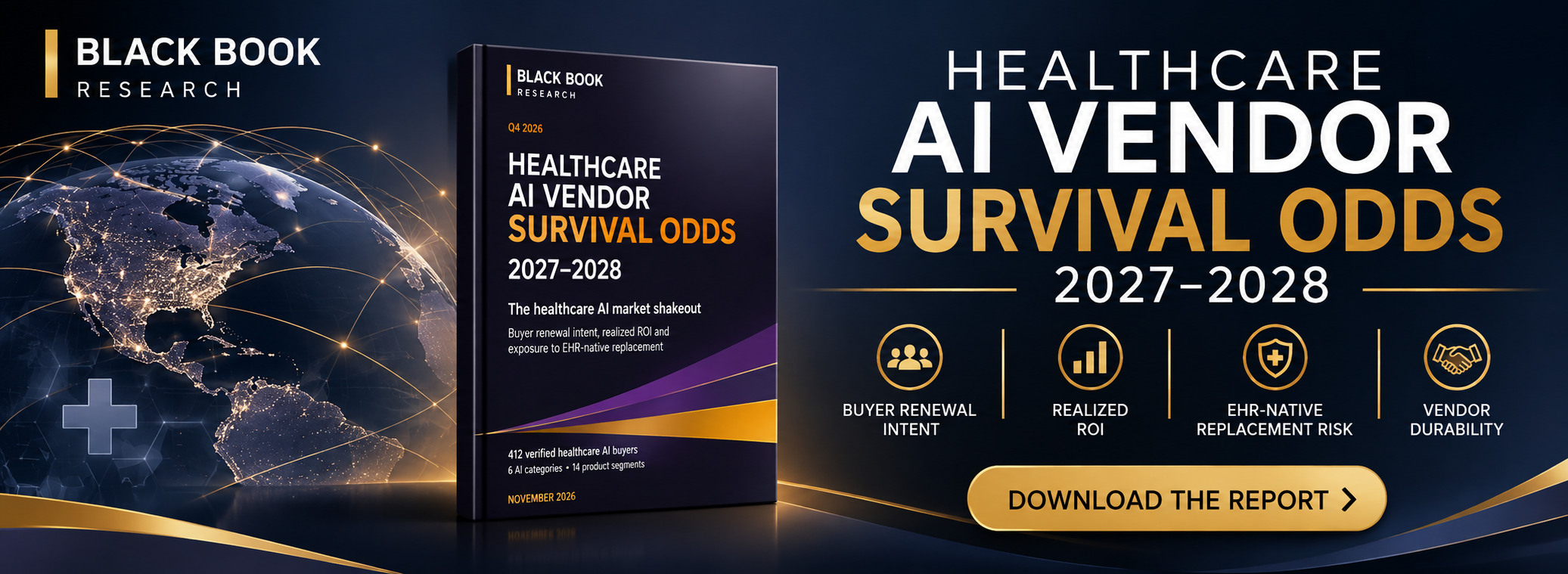
Download the Black Book Healthcare AI Vendor Survival Odds 2027–2028 Report
Healthcare AI is approaching a market-defining consolidation. New Black Book Research reveals which AI technologies are most vulnerable to replacement, why promised returns are falling short, and what will determine vendor survival through 2028.
Black Book Research has published Healthcare AI Vendor Survival Odds 2027–2028, an independent examination of the mounting financial, competitive and technological pressures reshaping the healthcare artificial intelligence market.
Based on 412 verified healthcare AI buyers across six technology categories and 14 product segments, the November 2026 study examines customer renewal intentions, realized return on investment, exposure to EHR-native AI capabilities and confidence in the continued independence of standalone AI vendors.
The central finding is consequential: Health systems plan to reduce their standalone AI vendor portfolios by approximately 44% by 2028, while buyers report realizing a median of just 41% of the financial returns promised at sale.
The next phase of healthcare AI will be determined less by the number of new products entering the market and more by which technologies healthcare organizations continue to purchase, renew and expand.
Healthcare AI Is Entering a Major Vendor Consolidation Cycle
The research identifies substantial changes in healthcare AI purchasing expectations.
-
9 to 5 vendors: The median health system plans to reduce its standalone AI vendor count from nine to five by 2028.
-
17 to 8 vendors: Health systems in the highest quartile of AI vendor adoption anticipate even sharper portfolio reductions.
-
41% realized ROI: Buyers report achieving a median of just 41% of the returns originally promised by AI vendors.
-
63% EHR replacement intent: Nearly two-thirds of Epic-based health systems plan to replace at least one standalone AI application with an EHR-native capability by 2028, compared with 34% of organizations using other EHRs.
-
3 of 11 ambient vendors: Buyers expect only three of today's 11 major ambient documentation vendors to remain independent by 2028.
-
71% contract exposure: More than seven in ten AI contracts lack change-of-control termination rights.
These findings reflect buyer assessments and forward-looking expectations rather than confirmed future vendor exits.

The Competitive Threat Is Shifting From AI Startups to Established EHR Platforms
Healthcare AI companies have traditionally competed on algorithm performance, speed of deployment, specialty capabilities and demonstrable clinical or operational improvements.
Black Book finds that EHR-native functionality is increasingly influencing purchasing and renewal decisions.
57% of surveyed buyers identify the availability of a comparable EHR-native feature as a reason they would discontinue a standalone AI vendor.
Another 49% cite failure to achieve promised ROI, while 36% identify concern about a vendor's potential acquisition or failure.
The findings suggest that AI products performing functions already controlled by enterprise EHR platforms may face increasing commercial pressure, even when customers are satisfied with their technical performance.
For emerging vendors, product differentiation must extend beyond isolated features toward integration, multi-workflow support and measurable operating results.
Which Healthcare AI Categories Appear Most Likely to Endure?
Black Book evaluated six major healthcare AI categories using its comparative Survival Index, combining customer renewal intentions, native EHR displacement exposure, realized ROI, perceived vendor financial stability and platform breadth.
| Healthcare AI category | Survival Index |
|---|---|
| Imaging and pathology AI | 73 |
| Patient communications and AI contact center | 71 |
| Clinical decision support and search | 66 |
| Revenue cycle AI | 64 |
| AI governance and orchestration | 60 |
| Ambient clinical documentation | 56 |


Imaging and pathology AI leads the category index, supported by strong renewal intentions and relatively limited EHR-native displacement exposure.
Patient communications and AI contact centers rank second, reflecting opportunities for growth despite increasing competition from EHR vendors and established contact-center platforms.
Revenue cycle AI presents a different opportunity. Buyers report a median 58% of promised ROI realized across the category, while broader automation platforms may gain share as narrowly focused tools are incorporated into integrated offerings.
Ambient clinical documentation faces the greatest category-level exposure to EHR-native replacement, although products that extend into coding, clinical documentation improvement and specialty workflows may be more defensible than general-purpose documentation tools.
Important: The Survival Index compares customer assessments on a 0–100 scale. It is not a statistical probability that an individual company will survive, remain independent or be acquired.
The AI Investment Story Is Moving From Adoption to Economic Durability
For venture capital, private equity, healthcare investors, investment banks and strategic acquirers, Black Book's findings introduce additional considerations when assessing healthcare AI company valuations.
Customer acquisition, recurring revenue, deployment counts and funding history do not independently establish the durability of an AI product.
The study identifies notable differences in customer confidence based on vendor characteristics.
Multi-EHR-integrated offerings achieve an average Survival Index of 77, compared with 46 for vendors dependent on a single EHR environment.
Vendors offering outcome-based or risk-sharing pricing achieve an average index of 75, while single-workflow point solutions score 50.
Companies associated with recent down rounds or reported layoffs receive the lowest average index, at 42.
These comparisons describe buyer perceptions and associations, not established causal relationships or company-specific failure predictions.
The emerging investment question is whether an AI company's revenue base can remain durable as customers consolidate suppliers and incumbent platforms introduce competing functionality.


A Significant AI Governance Gap Is Emerging Between Boards and CIOs
Black Book also identifies a substantial disconnect between board-level confidence and technology leadership assessments.
61% of board respondents believe their AI contracts provide protection if a vendor is acquired, compared with only 24% of CIOs.
Additional findings reveal that:
-
82% of AI contracts lack model or source-code escrow.
-
77% lack exit rights if an EHR vendor introduces an equivalent native capability.
-
71% lack change-of-control termination rights.
-
58% lack adequate data-portability and return provisions.
-
52% lack renewal price caps.
These gaps could complicate healthcare organizations' responses to acquisitions, vendor failures, product discontinuations and EHR platform consolidation.
Black Book identifies contractual portability, financial accountability and technology continuity as increasingly important components of enterprise AI governance.
One Independent Healthcare AI Buyer Research Panel
The study incorporates 412 verified healthcare AI buyers and Black Book's 2026 healthcare technology user-experience panel findings.
Research period: September 12–November 4, 2026.
Respondent groups include CIOs, CTOs, chief digital officers, CFOs, revenue cycle executives, CMIOs, clinical and AI leaders, hospital board members and ambulatory healthcare executives.
Participating organizations represent Epic, Oracle Health, MEDITECH, athenahealth and other enterprise technology environments.
The evaluation covers six categories and 14 product segments, examining customer-reported renewal intentions, realized financial returns, replacement risks, competitive positioning and expectations concerning vendor independence.
No AI vendor sponsored, reviewed or received advance access to the research. No investment firm or investor participated in or influenced the study.
Why the Findings Matter for 2027–2028
The research offers practical implications for several constituencies.
-
Healthcare systems and executives: Identify AI investments at greater risk of displacement, strengthen contract protections and prioritize technologies with measurable operational or financial returns.
-
Healthcare AI vendors: Understand the characteristics associated with stronger renewal intentions, greater enterprise relevance and improved customer confidence.
-
Venture capital and private equity investors: Evaluate customer retention exposure, EHR platform dependency and the sustainability of revenue assumptions supporting healthcare AI valuations.
-
Strategic acquirers and investment banks: Identify the product segments most likely to experience platform absorption, acquisition activity or competitive repositioning.
-
Healthcare technology analysts and policymakers: Examine the transition from rapid AI adoption toward market consolidation, procurement accountability and governance maturity.
The Great Healthcare AI Shakeout Has Begun
Black Book concludes that the healthcare AI market is entering a period in which technological innovation alone will not ensure commercial success.
The industry's next competitive leaders are more likely to be defined by sustained customer renewal, measurable economic value, workflow depth, integration flexibility and the ability to remain relevant as enterprise platforms expand their native AI capabilities.
The report provides healthcare providers, technology companies, investors, analysts and strategic decision-makers with an independent, customer-driven framework for interpreting the healthcare AI market's next major transition.